Dealing with Cold Spots in Complex Glassware
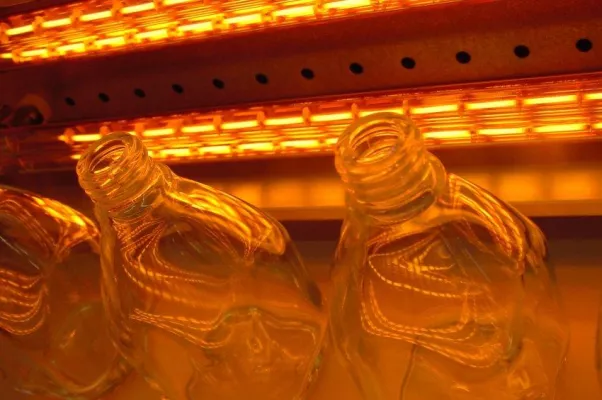
If you’ve ever worked with weirdly shaped glassware, you know the nightmare of “dead zones.” You put your pieces through a standard annealing lehr, but because the geometry is so irregular, some spots just stay cold. That’s a recipe for disaster. Those cold spots leave uneven stress in the glass, and before you know it, a piece spontaneously cracks. It’s frustrating and expensive. The trick to fixing this is shortwave infrared (IR) lamps. Most people rely on convection—basically blowing hot air—but air is lazy. It doesn’t always get into the tight spots. IR is different. It cuts right through and heats the glass directly. Getting the heat where it actually needs to go You can’t just throw one heat source at this and hope for the best. We usually set up arrays of quartz halogen lamps that basically wrap around the container. By playing with the angles and the spacing of the lamps, you can aim that energy right into deep recesses or those narrow necks where hot air usually gives up. The science part is pretty straightforward: shortwave IR packs a lot of power. It lets you hit that annealing point without turning your entire kiln structure into an oven. Just a heads-up, though—if you crank up the wattage to kill those dead zones faster, make sure your cooling fans can actually handle the extra heat building up around the lamp housings. Otherwise, you’re just swapping one problem for another. The gear side of things On the hardware front, we stick with R7s or SK15 connectors. Why? Because when a tube finally burns out—and they will—you want to be able to pop a new one in and get the line moving again. No one wants to spend an hour fiddling with wiring during a shift. We also use quartz envelopes. They let the IR energy pass through easily, so you aren’t wasting power. Making it work in the real world When you’re wiring these up for stress relief, the whole goal is balance. Glass is stubborn. Thick sections hold onto heat way longer than thin walls. If you treat the whole piece the same, you’re asking for trouble. The smart way to do it is by zoning your lamps. Give the thick bases more heat and dial it back for the rims. This evens out the cooling rate across the whole piece. It keeps the internal tension from building up, which is really the only way to make sure your glass doesn’t shatter during the final cool-down.